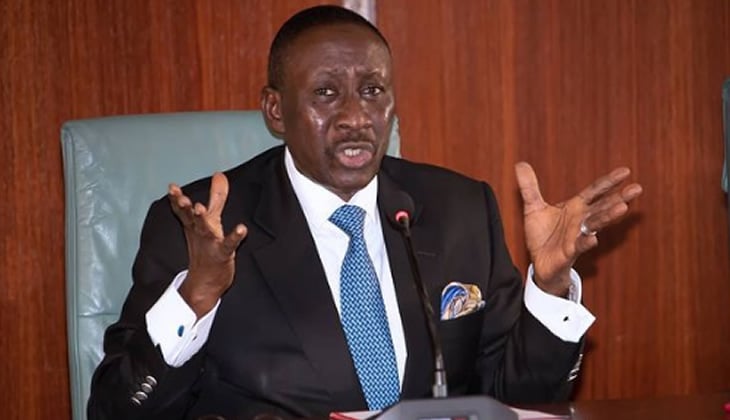
By any measure, Major General Babagana Monguno (rtd), Nigeria’s former National Security Adviser (NSA), has positioned himself as a voice for accountability in national security. In his recent commentary in From Soldier to Statesman: The Legacy of Muhammadu Buhari, Monguno described entrenched cabals within the presidency that undermined his office, claiming obstruction and sabotage of even routine security decisions. Yet a closer examination of his own tenure and actions reveals a pattern of selective transparency and unresolved controversy that raises substantive questions about his commitment to anti-corruption and institutional accountability.
The Arms Procurement Probe: Setup, Suspension, and Silence
In 2015, under President Muhammadu Buhari’s administration, Monguno constituted a Presidential Arms Procurement Investigative Committee chaired by Air Vice-Marshal John Ode (rtd) to examine alleged abuses and irregular spending in past military arms dealings. The committee’s mandate included investigating transfers of billions of dollars for arms procurement and reviewing contracts spanning multiple administrations. National Daily Newspaper+1
However, the Ode committee was disbanded after roughly 18 months amid conflicting signals from government sources. Some officials insisted the committee “ran its course” and was turned over to the Economic and Financial Crimes Commission (EFCC). Other insiders suggested the panel’s work had become politically sensitive, particularly when it widened its focus to include Monguno’s own tenure as Chief of Defence Intelligence. National Daily Newspaper
Critically, the full committee report from that arms probe was never publicly released, and its findings—rumoured to include evidence of widespread mismanagement—did not translate into comprehensive accountability or prosecution. Independent reviews of Nigerian corruption probes frequently note that reports of such panels “remain suppressed, and nobody has been indicted.” Nsukka Journal of the Humanities
Yet Monguno has rarely addressed this episode directly. While he now speaks of corruption and sabotage within the presidency, he was silent about the failure of his own presidential panel to deliver closure on one of the most consequential procurement scandals in recent Nigerian history.
Backtracking on Arms Funds: Public Confusion and Contradictions
Monguno’s BBC Hausa interview about missing arms procurement funds—which he later claimed was a misquotation—is another episode that underscores contradictions between his words and actions.
In the interview, he was widely reported to have stated that funds meant for arms procurement were untraceable and that newly appointed service chiefs could not account for weapons allegedly bought with those resources. This generated profound national controversy and political backlash. Independent Newspaper Nigeria
Subsequently, his office issued a statement denying that he had said funds were missing, asserting instead that he had been “quoted out of context” and that he was merely speaking generally about procurement processes. PM News Nigeria
This pattern—of making a startling claim and then reversing course under pressure—does not enhance public confidence. If Monguno believed corruption existed in arms procurement, why retract the assertion rather than insist on transparency and full forensic accounting? Critics, including civil society leaders at the time, argued that the public denial did little to clarify accountability for the special allocation funds or delivery of hardware. Independent Newspaper Nigeria
Leadership Criticisms and Calls for Accountability
Monguno’s tenure was not only controversial over procurement transparency but also subject to public criticism on leadership effectiveness. Groups such as the Northern Nigerian Professionals Forum publicly urged him to apologise or resign over his handling of security policy issues, describing his public communications as unprofessional. Blueprint
Similarly, the National Forum of Patriots called on President Buhari to sack him, citing what it described as a lack of initiative and strategic coordination in the fight against insurgency—an accusation that tied back to perceived failures in Monguno’s leadership and alleged involvement in arms procurement scandals. Independent Newspaper Nigeria
Missing Public Accountability: A Pattern or an Exception?
Across these episodes, a pattern emerges: Monguno speaks forthrightly about corruption within government structures—particularly against others—yet when it comes to controversial episodes tied to his own positions or investigations he oversaw, the record remains opaque.
-
A presidential panel he established did not produce a full public report; its findings vanished into bureaucratic limbo. Nsukka Journal of the Humanities
-
Documents and sources indicate the Ode panel ran into trouble when it examined aspects of Monguno’s own intelligence role. National Daily Newspaper
-
He made high-impact statements about missing procurement funds but later publicly retracted or reframed them. PM News Nigeria
On the broader allegations of personal corruption or links with other controversial figures such as Godwin Emefiele, publicly verifiable information remains less direct. There are no confirmed investigative findings or credible reporting definitively tying Monguno to corrupt enrichment with Emefiele. However, the pattern of political contention, ambiguity, and incomplete accountability suggests a need for rigorous scrutiny—especially from independent anti-corruption bodies empowered to pursue forensic investigation without political interference.
Conclusion: Hypocrisy or Opportunity for Transparency?
Monguno’s recent critiques of presidential inner circles carry rhetorical force, but they also expose a deeper paradox: a figure who positions himself as a champion of institutional integrity remains associated with unresolved episodes where transparency should have been his hallmark.
For Nigeria to genuinely confront corruption within national security and procurement, public figures must be held to consistent standards of accountability—whether speaking against corruption or managing probes entrusted to them.
Only then can Nigeria move beyond political narratives to substantive accountability and restore public trust in its security architecture.