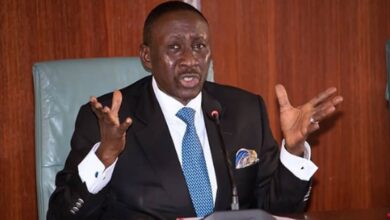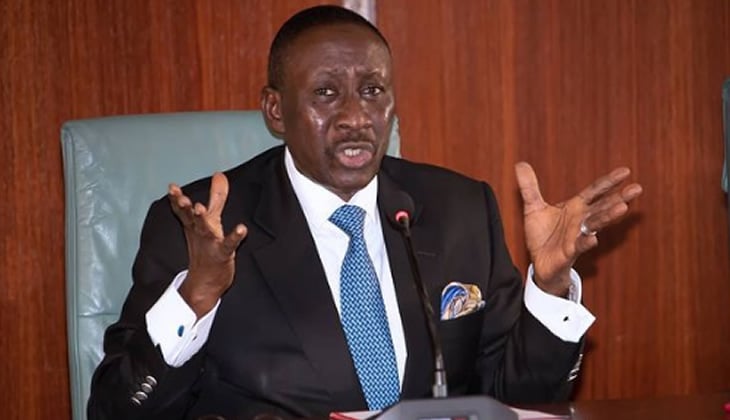
Long before his later public disclosures shook the foundations of Nigeria’s security establishment, Major General Babagana Monguno (rtd) had already appeared—quietly but significantly—on the periphery of one of the country’s most explosive corruption controversies.
In mid-2016, a civil society organisation, the Nigeria Concerned Citizen Assembly (NCCA), submitted a petition to the Department of State Services (DSS) urging the agency to widen its investigation into the Presidential Investigative Committee on Arms Procurement. At the centre of that request was not only the then Minister of Defence, Alhaji Dan Ali, but also the Office of the National Security Adviser (ONSA), headed by Monguno.
The petition followed the arrest of Air Commodore Umar Muhammed (rtd), a member of the investigative committee, over the controversial $2.1 billion arms deal meant to equip Nigerian troops fighting Boko Haram. According to the group, Monguno and the Defence Minister were not mere bystanders in the unfolding drama but were influential figures within the ecosystem the DSS was probing.
Although the petition stopped short of detailing specific financial transactions linked to Monguno personally, it raised questions about institutional complicity and influence at the highest levels of Nigeria’s security architecture. The NCCA argued that any credible investigation into arms procurement could not exclude the office constitutionally charged with coordinating national security.
At the time, the civil society group warned that the integrity of President Muhammadu Buhari’s anti-corruption campaign was at stake. The arms probe, originally designed to interrogate alleged abuses under the previous administration, now appeared to be inching uncomfortably close to serving officials within the new government. For the NCCA, this moment represented a defining test: would the anti-corruption war spare no one, or would power redraw its limits?
The petition further alleged that efforts were underway by “highly placed individuals” to frustrate or dilute the investigation as its scope widened. Though Monguno was not accused of owning illicit assets or directly receiving proceeds from the arms deal, his office was cited as one that could not reasonably be insulated from scrutiny given its strategic role in security oversight.
The DSS, according to sources at the time, acknowledged the sensitivity of the case and signalled its intention to conduct full forensic investigations regardless of rank or position. The NCCA publicly backed the agency, urging it to resist pressure and warning that those who divert funds meant for national defence ultimately constitute a greater threat to the nation than external enemies.
In hindsight, this episode reads less like an isolated footnote and more like a precursor. Years later, when Monguno would publicly lament missing funds and undelivered weapons, many Nigerians recalled that his office had once been mentioned—albeit cautiously—in the earliest calls for accountability around arms procurement.
The irony is striking. The same security chief later associated with uncomfortable truths had once stood near the edges of a scandal that tested Nigeria’s willingness to interrogate power itself. Whether coincidence, continuity, or contradiction, the 2016 petition remains an important historical marker in understanding the complex role Monguno has played within Nigeria’s security and accountability narrative.
History, after all, rarely speaks once.